Residential rodent exclusion is designed for homeowners experiencing persistent wall scratching, attic nesting, or droppings behind appliances who require permanent physical containment rather than toxic broadcast…
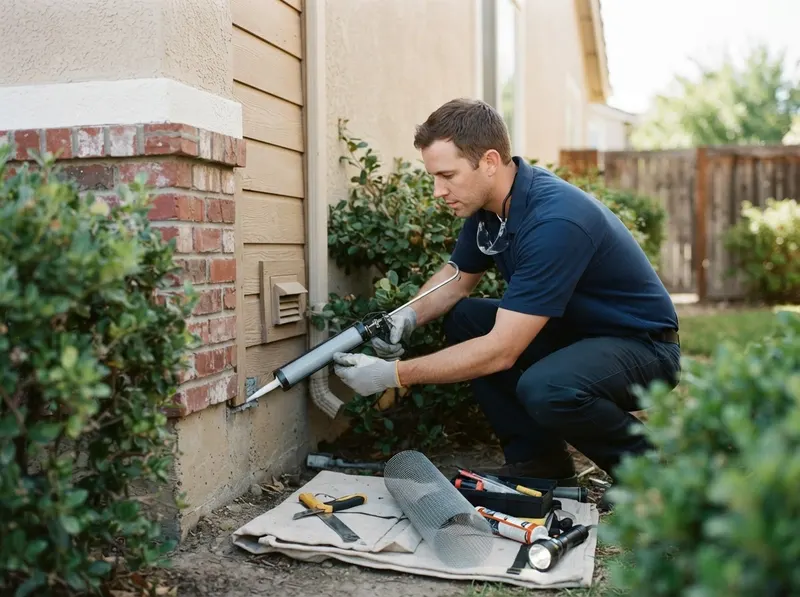
Residential rodent exclusion is designed for homeowners experiencing persistent wall scratching, attic nesting, or droppings behind appliances who require permanent physical containment rather than toxic broadcast baits. In suburban settings like East Elk Grove, Camden Park, and Laguna Creek, roof rats exploit tree branches overlapping composite shingle roofs to enter dormer corners and ridge caps. Meanwhile, properties situated near agricultural borders and riparian habitats, including Sheldon, Fallbrook, and communities adjacent to the Stone Lakes National Wildlife Refuge or the Cosumnes River Preserve, face seasonal migration of field mice and Norway rats searching for insulated wall voids during cold Central Valley winters. Traditional bait stations only manage populations temporarily; physical exclusion stops re-entry entirely by addressing construction gaps common to stucco-on-frame tract homes.
Technicians target specific architectural failure points according to guidelines established by the University of California Statewide Integrated Pest Management Program. Roof rats can enter a structure through openings as narrow as 1/2 inch (equivalent to the diameter of a standard coin), while adult house mice require only 1/4 inch. Technicians seal crawlspace louvers, foundation weep screeds, attic eyebrow vents, and air conditioning line penetrations using industrial 19-to-23-gauge galvanized wire mesh and exterior-grade elastomeric polyurethanes verified to resist gnawing. The trade-off between physical exclusion and chemical rodenticides is upfront labor vs recurring expense: physical barrier installations require detailed manual labor along rooflines and roof-wall junctions, but they prevent deceased rodents from decomposing inside drywall cavities and eliminate exposure risks for domestic pets and native raptors as outlined by the California Department of Fish and Wildlife.
Structural exclusion is executed through four defined stages: 1. A complete 360-degree perimeter assessment identifying rub marks, gnawed edges, and thermal drafts. 2. Mechanical closure of sub-floor vents, dryer vent flappers, and garage-door bottom astragals with heavy-gauge materials that align with standards from the National Pest Management Association. 3. Placement of non-poisonous wooden or mechanical snap traps in enclosed attic spaces to eliminate animals trapped inside the perimeter, avoiding chemical poisons that conflict with EPA rodent management regulations. 4. Retrieval and population clearing over a 14-day window. In newer developments such as Madeira and Lakeside, settlements around utility lines like flexible gas conduit and HVAC chase penetrations provide immediate highways into kitchens; sealing these areas prevents cross-contamination of pantries without introducing volatile organic compounds into living spaces, maintaining standards supported by the Centers for Disease Control and Prevention.
Homeowners in older communities such as Old Town Elk Grove and mature parcels along Laguna West benefit from inspecting tile underlayment, decorative wood fascias, and chimney flashing. Rodent exclusion adheres to structural ventilation minimums enforced under the California Building Standards Commission, ensuring attic and sub-floor air exchange remains unobstructed while screens remain fully pest-proof. Properties in Sacramento County facing localized waterway pressures from regional storm canals find that combining exterior brush clearing with mechanical hardware exclusion provides biosecurity without relying on ongoing monthly contract obligations, aligning with commercial hygiene expectations outlined by the Occupational Safety and Health Administration for safe residential premises.
Every job gets a firm, written price after a free on-site visit.
For standards, safe disposal, and service guidance on pest control services in Elk Grove, CA, useful references include U.S. EPA, ENERGY STAR, U.S. Dept. of Energy, Consumer.gov, U.S. Census Bureau, and Google Maps. General consumer and small-business resources are available from USA.gov, Better Business Bureau, FTC Consumer Advice, U.S. Small Business Administration, and Ready.gov.
Tell us about your residential rodent exclusion job in Elk Grove and we'll send a clear, written quote, usually the same day.
 QuickShield Exterminators